
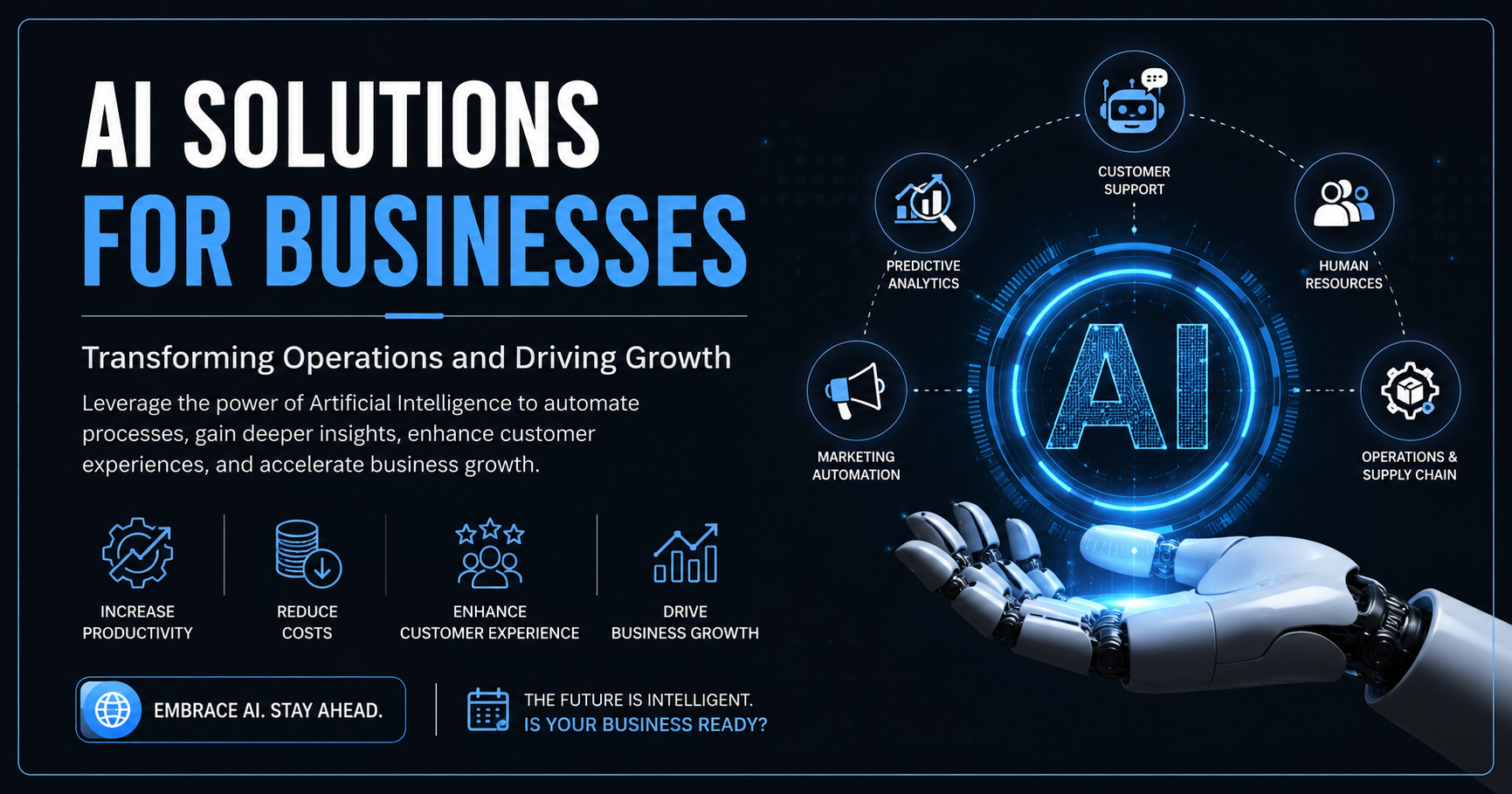
AI Solutions for Businesses: Transforming Operations and Driving Growth
Published on June 15, 2026 • Reading Time: 8 mins
The modern corporate landscape is undergoing a monumental paradigm shift. No longer a futuristic concept reserved for tech giants or science fiction, AI solutions for businesses have rapidly matured into essential infrastructure for forward-thinking enterprises. From agile startups to Fortune 500 companies, organizations across the globe are integrating cutting-edge intelligence into their daily workflows to unlock unprecedented levels of efficiency, innovation, and scalability.
In today’s hyper-competitive marketplace, relying solely on legacy systems is a recipe for stagnation. Industry leaders are actively leveraging sophisticated business AI solutions to eliminate operational bottlenecks, optimize human capital, and accurately predict shifting market dynamics. By embedding intelligence into core operational frameworks, companies are not just cutting overhead—they are uncovering entirely new revenue streams and radically enhancing profitability.
What Are AI Solutions for Businesses?
At their core, artificial intelligence for companies encompasses a broad spectrum of advanced digital software, cognitive frameworks, and automated infrastructure engineered to mimic human cognitive processes. Rather than replacing human oversight, these systems augment human capabilities, processing vast datasets at rates impossible for human minds to match.
The ecosystem of modern enterprise technology typically relies on several core architectural pillars:
- Machine Learning (ML): Algorithms that autonomously analyze data patterns, refine internal logic models, and improve operational execution accuracy over time without static programming.
- Natural Language Processing (NLP): The underlying technology enabling computer interfaces to seamlessly comprehend, parse, interpret, and accurately respond to human speech and text structures.
- Computer Vision: Advanced visual recognition software engineered to analyze visual inputs (such as digital video feeds or images) and extract context-rich actionable insights.
- Robotic Process Automation (RPA): Digital execution bots configured to effortlessly handle repetitive, high-volume transactional administrative tasks.
The explosive rise in global adoption is driven by the unprecedented convergence of cloud computing power, widespread mobile digitization, and the sheer volume of enterprise data generated daily. Organizations that fail to deploy intelligent architectures risk operating with blind spots in highly optimized markets.
Strategic Market Insight
According to recent global enterprise surveys, organizations implementing robust AI transformation services report an average 30% increase in operational efficiency and a massive reduction in administrative overhead within the first 18 months of deployment.
Key Benefits of AI Solutions for Businesses
Investing in professional AI integration services unlocks profound structural advantages that ripple through every department of an enterprise.
- Unprecedented Productivity: Systematically automating tedious, manual administrative tasks allows human talent to shift focus back to creative innovation, relationship management, and high-level strategic growth.
- Substantial Cost Reduction: Intelligent automation minimizes human data-entry errors, optimizes resource utilization parameters, and reduces operational waste across backend workflows.
- Elevated Customer Experiences: Instantaneous, localized, and contextually aware support ensures consumers receive immediate resolutions around the clock, driving brand loyalty metrics.
- Smarter, Faster Decision-Making: Stripping cognitive guesswork out of business decisions by evaluating millions of datapoints in real-time gives executives reliable predictive certainty.
- Deep Data-Driven Insights: Uncover hidden correlations within legacy internal documentation, structural silos, and consumer buying trends that manual analysts would likely overlook.
- Proactive Cybersecurity: Autonomous monitoring algorithms detect anomalies, recognize suspicious security patterns, and isolate system vulnerabilities to neutralize threats before data breaches occur.
- Agile Scalability: Digital workflows scale infinitely to accommodate rising consumer demand without requiring a linear, costly increase in headcount.
Top AI Solutions Businesses Are Using Today
Modern organizations leverage targeted software deployments to address specific friction points in their daily operating models.
AI-Powered Customer Support
Advanced digital interfaces have evolved significantly beyond simple script-based chat paths. Modern customer service platforms integrate NLP models that read emotional sentiment, handle highly complex customer technical inquiries, and offer personalized solution recommendations instantly. These autonomous assistants maintain 24/7/365 availability, ensuring client concerns are handled without delay.
Predictive Analytics
By implementing robust machine learning solutions, enterprises can process historical sales information alongside macroeconomic trends to build incredibly precise financial forecasts, anticipate inventory requirements, and spot macroeconomic market shifts before competitors do.
Marketing Automation
Achieving sustained AI-powered business growth requires precision marketing. Cognitive systems automatically segment audiences based on deep web behaviors, deliver dynamic hyper-personalized content, and execute real-time lead scoring to pass high-intent prospects straight to your sales team.
AI in Human Resources
Human resource divisions utilize algorithmic screening tools to parse thousands of incoming digital resumes, isolating elite talent in a fraction of the time. Additionally, predictive sentiment analytics gauge ongoing team morale through internal surveys to maximize workforce retention.
AI for Operations and Supply Chain Management
Intelligent systems continuously optimize modern enterprise supply networks. They dynamic-route logistics fleets around traffic, predict precise component manufacturing requirements to support “Just-In-Time” inventory models, and handle warehouse sorting workflows to maximize delivery speeds.
Industries Benefiting from AI Solutions
Intelligent technology is industry-agnostic, rewriting the rulebook for diverse professional fields:
Healthcare: Speeds up diagnostic imaging analysis, automates clinical documentation workflows, and accelerates pharmaceutical trial discoveries.
Finance: Empowers algorithmic trading desks, executes rapid fraud detection, and builds custom consumer credit scoring models.
Retail & E-commerce: Fuels predictive product recommendation feeds, manages virtual fitting mirrors, and dynamically adjusts web pricing metrics.
Manufacturing: Drives industrial robotic automation and monitors IoT acoustic sensors for predictive machine maintenance.
Real Estate: Analyzes spatial demographic data to compute property valuations and automates commercial property management alerts.
Education: Creates personalized student learning curricula and auto-grades foundational testing modules.
How to Successfully Implement AI in Your Business
Executing a smooth AI business transformation requires a structured approach rather than rushed adoption:
Challenges of AI Adoption and How to Overcome Them
Transitioning to highly automated architectures is not without friction. Understanding common obstacles allows you to build an effective deployment strategy:
- Data Privacy & Security Concerns: Solution: Deploy strict data governance frameworks, ensure full regulatory compliance (GDPR/CCPA), and leverage end-to-end data encryption mechanisms.
- Integration with Legacy Infrastructure: Solution: Avoid stripping out entire architectures at once. Utilize robust modern API layers to incrementally bridge older networks with new software.
- Employee Resistance: Solution: Run internal workshops demonstrating how automation eliminates tedious work rather than replacing personnel, cultivating an automation-first company culture.
- Initial Investment Costs: Solution: Focus initial efforts on low-risk, high-return proofs-of-concept (POC) to quickly prove ROI before committing capital to massive infrastructural shifts.
The Future of AI Solutions for Businesses
The evolutionary arc of AI technology for businesses points toward a landscape of deeper synthesis and autonomy:
- Generative AI Expansion: Moving beyond drafting basic copy to dynamically designing technical products and codebases on demand.
- Autonomous Workflows: Multi-agent software setups communicating directly with other networks to handle multi-step strategic projects with zero human intervention.
- Hyper-Personalization: E-commerce frameworks adapting structural layouts, pricing structures, and offerings dynamically for individual users in real-time.
Why Choose Professional AI Development Services
While generic software options exist, scale-ready corporations require tailored precision. Partnering with professional AI automation services guarantees custom builds that respect your distinct brand workflows. Professional engineering reduces deployment timelines, eliminates common architectural security bugs, and delivers a substantially stronger long-term ROI.
By utilizing experienced engineering talent, your business secures reliable post-deployment system optimization, keeping your underlying technical stack efficient as data standards evolve.
Embrace the Future of Enterprise Intelligence
Integrating modern, specialized technology is no longer an optional luxury—it is an absolute operational necessity for long-term survival. Embracing these advanced capabilities empowers your enterprise to out-pace market competitors, optimize resource workflows, and build an incredibly agile, future-proof organization.
Ready to Transform Your Business Operations?
Don’t let legacy workflow bottlenecks hold your organization back. Contact our premier engineering team today to book your dedicated strategic consulting session and unlock scalable growth.
Frequently Asked Questions (FAQ)
What are AI solutions for businesses?
They consist of tailored technical systems, automation software, and machine learning models designed to run data analysis, automate repetitive workflows, and enhance executive decision-making across an enterprise.
How can AI improve business productivity?
By offloading highly repetitive administrative tasks, structural manual processing, and information routing onto automated systems, freeing your staff to focus entirely on high-value strategy and creative problem-solving.
Is AI suitable for small businesses?
Absolutely. Scalable cloud-based tools allow smaller companies and growing startups to compete directly with massive international brands by automating customer support paths and digital marketing execution affordably.
What industries benefit most from AI?
While finance, healthcare, e-commerce, manufacturing, and real estate are leading the early adoption curve, any business sector dealing with large amounts of data or routine processes can benefit immensely.
How much does AI implementation cost?
The financial investment varies extensively depending on scope. Ready-made cloud integrations can cost very little per month, while complex enterprise solutions tailored to legacy databases are priced based on software scale and data engineering requirements.