
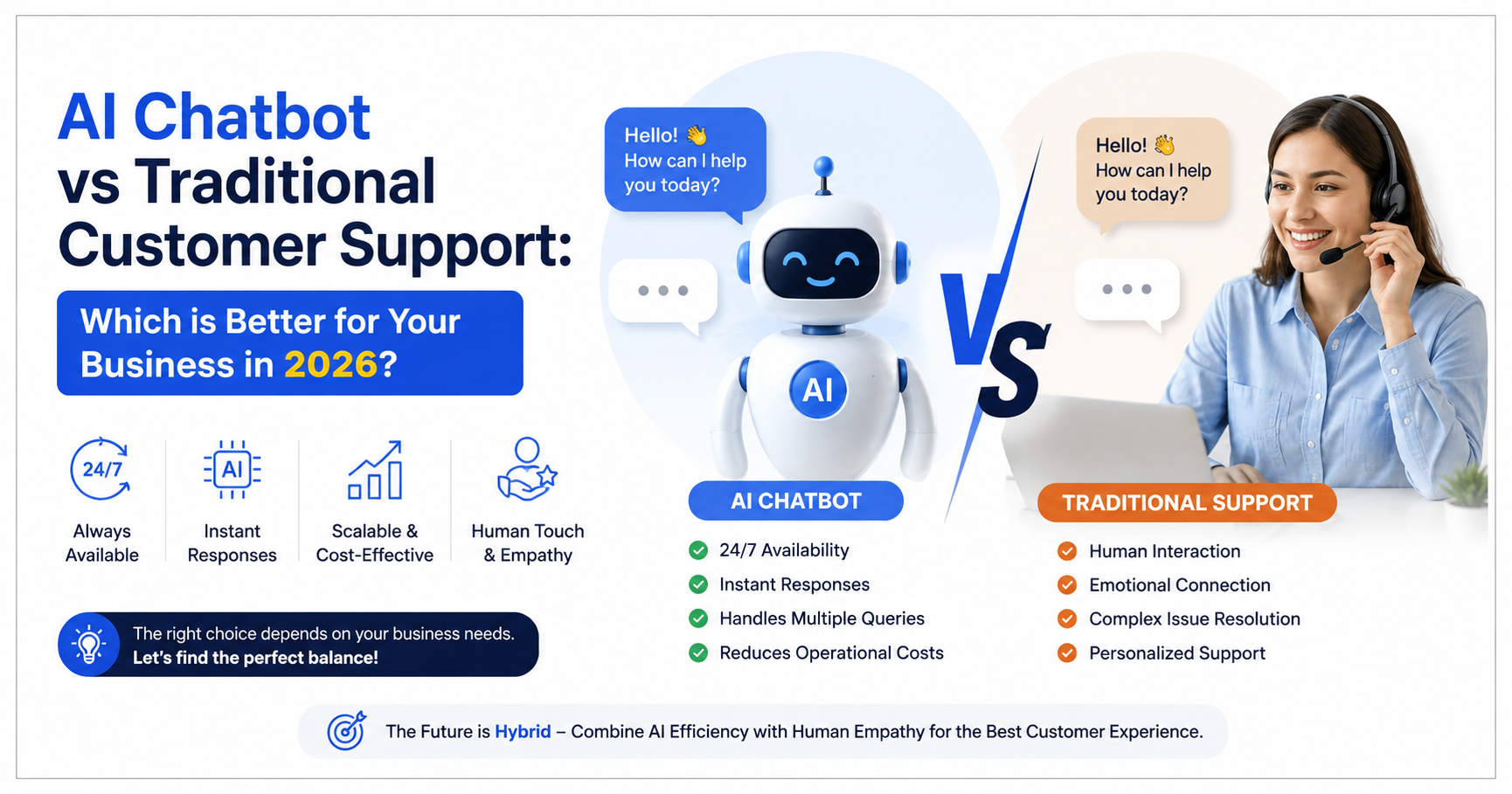
If you run a business in 2026, you’ve probably already asked yourself the question every founder eventually faces: Should you stick with your traditional customer support team, or move toward an AI chatbot? The honest answer is that AI chatbot vs traditional customer support isn’t a simple either-or decision anymore — it’s about understanding what each model does well, where it falls short, and how the two can actually work together. This post breaks down the real differences so you can make a decision that fits your business, your budget, and your customers.
What is Traditional Customer Support?
Traditional customer support means real people answering real questions — over the phone, through email, or on live chat. It’s been the backbone of customer service for decades, and for good reason. People trust people, especially when something has gone wrong with an order or a service.
What works well:
- Genuine empathy when a customer is frustrated or upset
- Strong judgment on complex or unusual situations
- Builds long-term trust and loyalty
Where it struggles:
- Limited hours unless you’re paying for round-the-clock shifts
- Higher ongoing cost — salaries, training, turnover
- Slower response times when ticket volume spikes
- Hard to scale fast during busy seasons or product launches
What is an AI Chatbot?
An AI chatbot uses natural language processing to understand and respond to customer questions automatically. The chatbots businesses are deploying today aren’t the clunky, scripted bots from a few years ago — modern ones can answer FAQs, track orders, qualify leads, and hand off to a human the moment a conversation gets complicated.
What works well:
- Answers instantly, 24 hours a day, with no extra staffing cost
- Scales effortlessly — a busy Monday costs the same as a quiet Tuesday
- Lowers support costs over time once it’s set up
- Captures useful data on what customers are actually asking about
Where it struggles:
- Can stumble on emotionally charged or unusual requests
- Needs upfront investment in setup and training
- Requires regular updates to stay accurate as your business changes
Side-by-Side Comparison
| Factor | AI Chatbot | Traditional Support |
|---|---|---|
| Cost (long-term) | Lower after setup | Higher, ongoing |
| Response Speed | Instant | Minutes to hours |
| Scalability | High | Limited by headcount |
| Personal Touch | Moderate | High |
| Complex Issue Handling | Needs human handoff | Strong |
Why a Hybrid Approach Wins in 2026
The businesses getting the best results right now aren’t choosing one side over the other — they’re combining both. An AI chatbot handles the repetitive stuff: order status, FAQs, basic troubleshooting, lead qualification, all day and night. The moment a conversation needs judgment, empathy, or a decision outside the bot’s training, it hands off to a real person.
This setup cuts support costs, speeds up response time across the board, and still gives customers a real human when it matters most. For small and mid-sized businesses, especially, investing in chatbot development services is one of the highest-return automation tools available right now.
Final Thoughts
AI chatbots aren’t trying to replace your support team — they’re there to absorb the volume so your team can focus on the conversations that actually need a human. Businesses adopting this hybrid model are already seeing faster response times, lower support costs, and happier customers heading into the rest of 2026.
Thinking about adding AI customer support to your business?
Our team builds custom chatbots designed around your industry, your customers, and how you actually operate — built to scale as you grow.
https://itcompanymohali.in/ai-solutions-for-businesses/
Frequently Asked Questions
Are AI chatbots better than human support?
Not universally. AI chatbots win on speed and availability, while human agents win on empathy and handling complex issues. Most businesses get the best results by combining both.
How much does it cost to develop an AI chatbot for my business?
Cost depends on complexity, the platforms it needs to integrate with, and how advanced the conversation flow needs to be. Simple FAQ bots cost far less than AI-driven systems connected to a CRM or order system.
Can AI chatbots handle customer complaints?
Basic chatbots can log and acknowledge complaints, but anything emotional or high-stakes should be escalated to a human agent for proper resolution.
Will AI chatbots fully replace customer support teams?
Unlikely anytime soon. Most businesses are heading toward hybrid support, where AI handles volume and routine queries while humans handle nuance and judgment calls.