
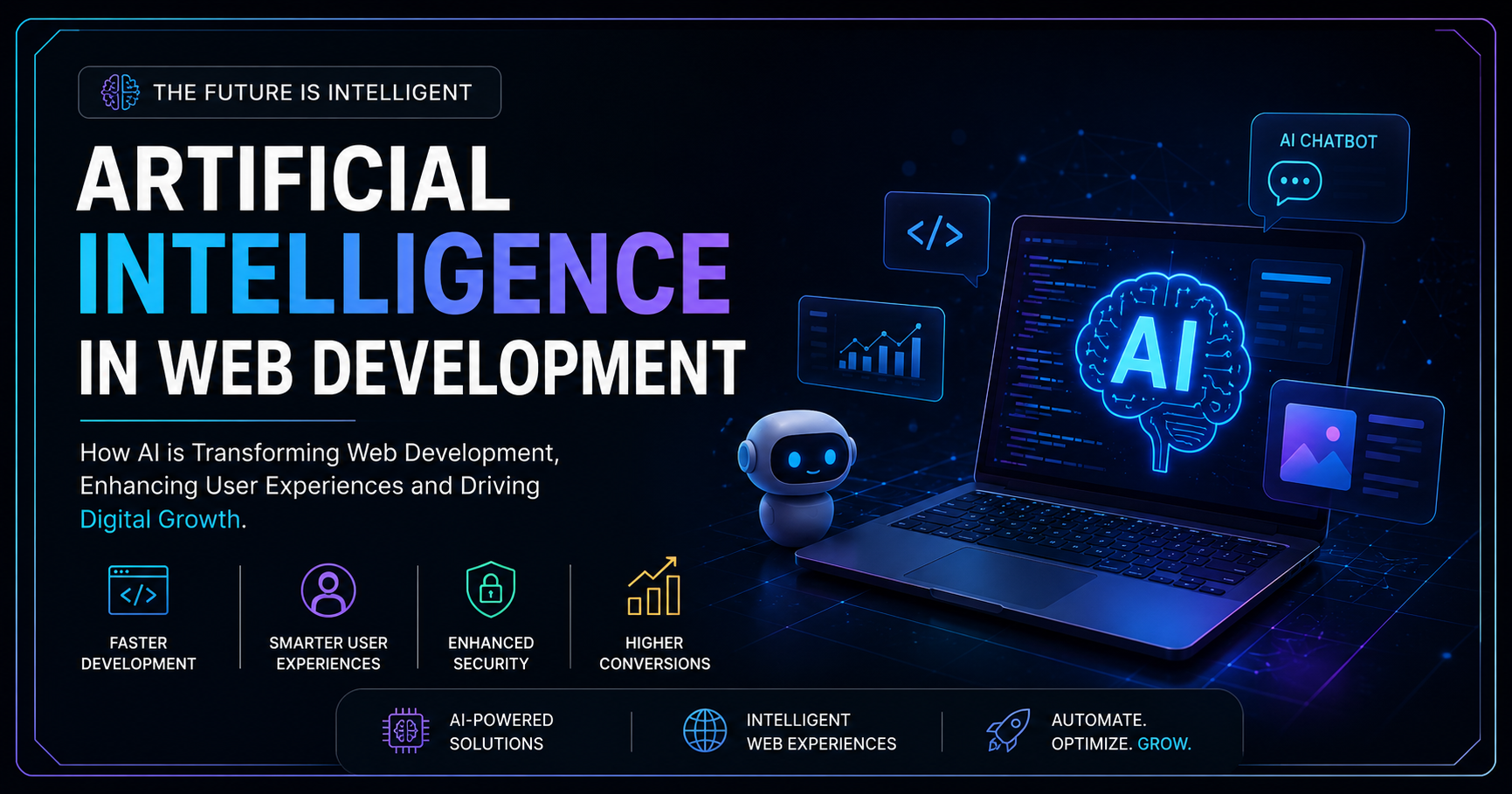
Artificial Intelligence in Web Development: The Ultimate Guide to Transforming Modern Digital Experiences
Published on: June 15, 2026 | Reading Time: 8 minutes
The digital landscape is shifting at an unprecedented velocity, and at the absolute center of this transformation is Artificial Intelligence in Web Development. Gone are the days when building a website required manual, line-by-line coding, static layouts, and rigid user experiences. Today, forward-thinking businesses, startups, and enterprise engineering teams are leveraging intelligent automation to construct highly dynamic, intuitive, and conversion-optimized web applications.
As consumer expectations skyrocket, traditional development workflows are no longer sufficient to keep pace. By integrating machine learning models, natural language processing (NLP), and algorithmic automation, companies can deploy complex platforms in record time. Whether you are an entrepreneur looking to launch your first SaaS product, a business owner aiming to optimize an e-commerce platform, or a software engineer seeking to scale your output, understanding how AI redefines web architecture is no longer optional—it is a critical competitive advantage.
What is Artificial Intelligence in Web Development?
At its core, Artificial Intelligence in Web Development refers to the practice of embedding cognitive computing technologies, machine learning models, and automated algorithmic logic into the lifecycle of website creation, maintenance, and user interaction. Instead of relying solely on static, pre-written code scripts, AI-driven platforms analyze massive data sets to recognize patterns, make autonomous design decisions, and continuously optimize user interfaces in real time.
Modern integration of AI website development spans multiple layers of a digital product. It functions quietly in the backend to manage database structures and spot cybersecurity anomalies, while simultaneously powering the frontend to dynamically shift visual elements based on specific user behavior. Consequently, this intersection of data science and web engineering yields intelligent digital solutions that adapt fluidly to whoever is interacting with them, ensuring that no two user journeys are identical.
How AI is Revolutionizing Web Development
The deployment of artificial intelligence web design and development tools has fundamentally restructured everyday workflows. Here are the primary ways smart automation is transforming code creation and system deployments:
1. Automated Coding
Generative AI models act as co-pilots for programmers, translating natural language prompts into clean, functional code blocks, completing syntax instantly, and debugging complex algorithms automatically.
2. Intelligent Design Suggestions
Design systems utilize machine learning to analyze user engagement maps, suggesting context-aware color palettes, spatial layouts, and typography choices tailored to maximize readability.
3. Website Personalization
Web platforms dynamically re-arrange conversion elements, banners, and navigation menus based on individual visitor histories, physical location, and explicit browsing intent.
4. Advanced Conversational Chatbots
Modern large language models handle customer service inquiries with nuanced, human-grade empathy, resolving intricate transaction issues and capturing qualified business leads 24/7.
5. Predictive Analytics
By constantly aggregating telemetry data, web applications can accurately forecast server traffic spikes, detect impending database bottlenecks, and proactively adjust infrastructure resources.
6. Real-Time Content Generation
AI mechanisms allow applications to generate contextual microcopy, targeted product descriptions, and dynamic multi-language translations instantly upon user request.
7. Automated QA Testing
Intelligent test scripts execute millions of synthetic user journeys simultaneously, discovering visual layout regressions, dead links, and software bugs before code updates hit production engines.
8. Enhanced Cybersecurity
Continuous anomaly detection systems rapidly recognize malicious patterns, isolating Distributed Denial of Service (DDoS) attempts and SQL injections before they compromise sensitive client data.
Key Benefits of AI-Powered Web Development
Investing heavily in AI-powered web development yields monumental downstream returns for agile business operations. The strategic benefits include:
- Accelerated Speed to Market: Automation truncates development sprints, turning complex, multi-month build schedules into highly streamlined, multi-week engineering deployments.
- Minimized Operational Overhead: Routine debugging, basic coding tasks, and boilerplate generation are handled autonomously, allowing small dev teams to operate with enterprise-level efficiency.
- Frictionless User Experiences (UX): Websites self-optimize layout patterns based on live behavioral feedback, eliminating layout friction points and vastly improving accessibility scores.
- Flawless Technical Performance: Predictive caching and dynamic asset optimization keep web pages exceptionally responsive, driving down core web vital latency metrics.
- Proactive System Hardening: Instead of executing post-breach mitigation, integrated machine learning modules recognize vulnerabilities and patch server instances preemptively.
- Maximized Conversion Funnels: Delivering hyper-targeted calls-to-action (CTAs) and personalized product grids shifts user engagement upward, driving measurable conversion gains.
- Empirical Data-Driven Insights: Shift away from speculative creative choices and anchor your optimization strategy in precise data points generated from actual interface usage.
Popular AI Tools for Web Developers
The marketplace for specialized AI tools for web developers has matured immensely, providing robust options across every layer of the digital tech stack:
| Tool Name | Primary Application Layer | Core Technological Functionality |
|---|---|---|
| GitHub Copilot | Software Engineering & IDE | Provides real-time code autocomplete suggestions, translates logic parameters, and builds full functions. |
| ChatGPT / Claude API | System Architecture & Content | Generates functional system blueprints, reviews legacy code scripts, and provides high-quality dynamic microcopy. |
| TensorFlow | Backend Logic & Deep Learning | Allows web developers to build, train, and run custom recommendation models natively inside web servers. |
| OpenAI APIs | Interactive Applications | Integrates advanced natural language processing features directly into client-facing web portals and chatbots. |
| Adobe Sensei | Asset Creation & UI Design | Automates complex image manipulation, extracts design metadata, and facilitates smart cropping across layouts. |
| Wix ADI | No-Code Rapid Prototyping | Generates entire functional websites within minutes based on basic contextual text questionnaires. |
| Framer AI | Frontend Layout & UX Production | Converts complex textual descriptive text into structured, mobile-responsive frontend mockups instantly. |
AI Applications in Frontend and Backend Development
To understand the impact of automation, it helps to dissect how AI interacts with the two primary layers of web infrastructure:
Strategic Execution: AI in Frontend Development
Frontend engineering focuses entirely on user-facing touchpoints. Implementing AI in frontend development transforms visual elements into living, reactive modules through:
- Smart UI/UX Design: Layout components structurally adapt to individual browser dimensions and accessibility patterns without breaking spatial frameworks.
- Personalized Interfaces: Platforms record user habits, shifting priority feature sets to the primary view and dimming secondary components to prevent cognitive overload.
- Automated Content Recommendations: Users receive bespoke product feeds or editorial content arrays based on real-time browsing behaviors.
- Predictive Search Fields: Integrated search boxes process typos, contextually interpret semantic query intent, and yield accurate results before the user finishes typing.
Operational Backbone: AI in Backend Development
Conversely, implementing AI in backend development safeguards architectural integrity, managing complex structural engineering behind the scenes via:
- Database Query Optimization: AI models analyze complex read/write operations, restructuring indexes dynamically to accelerate database retrieval cycles.
- Automated Security Monitoring: Continuous log scanners identify malicious activities, rate-limiting malicious bots and sealing system gaps autonomously.
- Server Resource Scaling: Algorithms project incoming traffic patterns, automatically calling for additional virtual servers during surges and scaling down during lulls to control infrastructure expenditure.
Challenges of Using AI in Web Development
While the growth runway is immense, adopting automated models introduces real-world hurdles that digital management teams must carefully navigate:
- Data Privacy and Compliance: Training predictive systems requires massive quantities of user analytics. Companies must construct strict data governance frameworks to align with rigid regulations like GDPR and CCPA.
- Initial Capital Expenditures: Embedding complex machine learning models can carry substantial initial integration costs, requiring specialized platform tooling and experienced data engineers.
- Ethical Algorithm Bias: If initial tracking data profiles carry inherent human biases, the automated design decisions generated by the software will inadvertently amplify those discrepancies.
- Over-Dependency Hazards: Over-reliance on auto-generated code scripts can dilute structural problem-solving abilities inside developer teams, creating massive liabilities when anomalous engine bugs arise.
- Code Accuracy & Hallucinations: Generative models occasionally manufacture invalid code parameters or deprecate standard security best practices, demanding thorough human peer review before deployment.
The Future of Artificial Intelligence in Web Development
Looking down the horizon, the trajectory of the internet will become completely decentralized, fluid, and customized. We are rapidly transitioning away from rigid layouts toward hyper-personalized web applications that adapt dynamically to individual end-users. The future will focus heavily on voice search integration, allowing users to effortlessly navigate intricate corporate platforms using spoken language commands.
Furthermore, predictive consumer tracking will allow web platforms to pre-render layout views before a customer clicks a button, effectively eliminating perceived latency. As autonomous pipelines advance, software systems will evolve to self-repair broken script arrays, track conversion trends, and execute continuous AI website optimization without requiring manual human maintenance.
Why Businesses Must Embrace AI Website Development Services
For modern enterprises, implementing automated technology is no longer just a trend—it is an existential imperative for long-term survival. Embracing specialized AI development services provides distinct business advantages:
Unfair Market Lead
Deploy strategic upgrades, new features, and functional marketing pages significantly ahead of slower competitors.
Amplified ROI Metrics
Drastically reduce production time frames and minimize costly post-launch software debugging expenses.
Sticky Engagement
Keep visitors on-site longer through bespoke recommendations and hyper-personalized interface designs.
Infinite Scalability
Support large-scale user traffic spikes smoothly without crashing servers or degrading platform performance.
Conclusion
Integrating Artificial Intelligence in Web Development marks a major turning point in how humans design and interact with the web. From generating code scripts with GitHub Copilot to serving clients via advanced chat frameworks, automation helps companies build fast, secure, and highly adaptive web platforms.
Do not let your digital real estate slide into obsolescence. Partner with an forward-thinking web services provider today to integrate machine learning into your systems, maximize conversion funnels, and solidify your digital footprint for the future.
Frequently Asked Questions
What is Artificial Intelligence in Web Development?
It is the practice of embedding machine learning, automated scripts, and analytical AI models into the web development lifecycle to automate code production, optimize layout designs, and personalize user journeys in real time.
How does AI improve website performance?
AI optimizes performance by predicting system traffic spikes, automatically compressing heavy image assets, managing server workloads, and restructuring backend database scripts to minimize page load speeds.
Which AI tools are commonly used in web development?
Popular industry choices include GitHub Copilot for code assistance, ChatGPT/Claude for script architecture, Adobe Sensei for image automation, and Wix ADI or Framer AI for rapid UI prototyping.
Is AI replacing web developers?
No, AI is not replacing developers. Instead, it serves as an advanced collaborative tool. It automates repetitive coding tasks, allowing engineers to focus on high-level system architecture, custom feature design, and creative user problem-solving.
What is the future of AI-powered web development?
The future features highly decentralized, hyper-personalized web portals that self-adjust layout structures based on user habits, full voice-command interface navigation, and autonomous platforms that debug and secure themselves.