
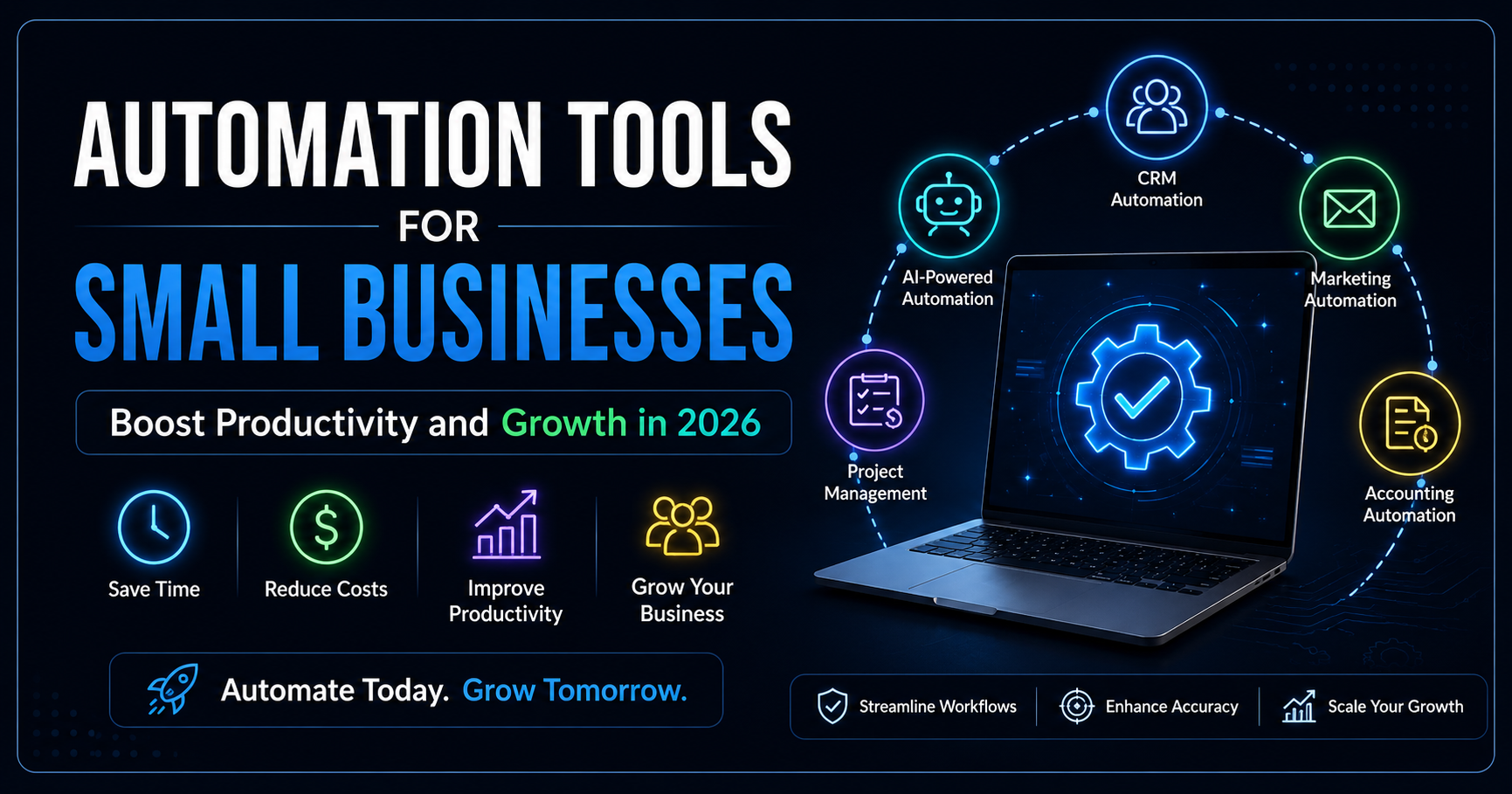
Automation Tools for Small Businesses: Boost Productivity and Growth in 2026
Running a small business in 2026 means wearing a dozen hats at once. Between managing customers, marketing your brand, tracking finances, and keeping projects on schedule, time becomes your most valuable resource. That’s why automation tools for small businesses have become essential rather than optional. They help reduce repetitive manual work, minimize human error, and free up your team to focus on strategy and growth.
Today, automation is no longer reserved for large enterprises with big budgets. Affordable, easy-to-use platforms now let even the smallest teams streamline operations, automate marketing campaigns, manage customer relationships, and handle accounting tasks efficiently. Add the rapid rise of AI-powered automation, and small businesses now have access to tools that were once unimaginable. In this guide, we’ll explore the best automation tools for small businesses in 2026, the benefits they offer, and how to choose the right solutions for your unique needs.
What Are Automation Tools for Small Businesses?
Automation tools are software platforms designed to perform repetitive tasks automatically, with minimal human intervention. Instead of manually sending follow-up emails, updating spreadsheets, or assigning tasks one by one, these tools handle the work based on predefined rules and triggers.
For example, a piece of business automation software can automatically send a welcome email when a new customer signs up, update a CRM record when a deal closes, or generate an invoice the moment a service is delivered. By removing manual steps from everyday processes, these tools help small businesses save time, reduce costly errors, and boost overall productivity.
The core benefits include significant time savings, fewer mistakes caused by manual data entry, faster turnaround on routine tasks, and the ability for small teams to accomplish more without hiring additional staff. As competition increases, businesses that embrace workflow automation tools gain a meaningful edge over those still relying on outdated manual processes.
Key Benefits of Business Automation
Adopting automation isn’t just about convenience — it directly impacts your bottom line. Here are the most important advantages small businesses experience after implementing automation.
Increased efficiency: Automated workflows complete tasks faster and more consistently than manual processes, allowing your team to focus on higher-value work.
Cost reduction: By reducing the need for manual labor on repetitive tasks, automation software solutions help lower operational costs over time.
Better customer experience: Automated responses, follow-ups, and personalized communication ensure customers receive timely attention, improving satisfaction and loyalty.
Improved employee productivity: When mundane tasks are automated, employees can dedicate their energy to creative, strategic, and customer-facing activities.
Enhanced data management: Automation tools centralize and organize data, reducing duplication and making information easier to access and analyze.
Faster decision-making: With real-time data and automated reporting, business owners can make informed decisions quickly rather than waiting on manual reports.
Top Automation Tools for Small Businesses in 2026
The market is filled with options, but some platforms stand out for their reliability, ease of use, and value. Below is a breakdown of the top categories and tools to consider.
1. CRM Automation Tools
CRM automation helps businesses manage leads, track interactions, and nurture customer relationships without manual follow-ups. Popular options include HubSpot, known for its all-in-one marketing and sales hub; Zoho CRM, a budget-friendly choice with strong customization; and Salesforce, a powerful enterprise-grade platform that scales well as businesses grow.
2. Marketing Automation Tools
Marketing automation tools allow businesses to schedule campaigns, segment audiences, and personalize messaging at scale. Mailchimp remains a favorite for email marketing and simple automation workflows. ActiveCampaign combines email marketing with CRM features for more advanced targeting. Brevo (formerly Sendinblue) offers email, SMS, and chat automation in one affordable package.
3. Project Management Automation
Keeping projects organized is easier with automation built into task management. Trello uses simple boards with automation rules for moving cards and assigning tasks. Asana offers robust workflow automation for teams managing multiple projects. Monday.com provides highly visual dashboards with customizable automation triggers.
4. Accounting Automation
Financial automation reduces errors and saves hours of manual bookkeeping. QuickBooks automates invoicing, expense tracking, and tax calculations. Xero offers cloud-based accounting with bank feed automation. FreshBooks is ideal for freelancers and small teams needing simple invoicing and time tracking automation.
5. AI-Powered Business Automation
AI automation for businesses has rapidly expanded what’s possible. AI-powered chatbots handle customer inquiries around the clock, reducing response times and support costs. AI customer support tools can triage tickets, suggest solutions, and escalate complex issues automatically. AI content generation tools help small businesses create marketing copy, social media posts, and product descriptions faster than ever. Meanwhile, workflow automation powered by AI can analyze patterns and optimize processes without constant human oversight, making intelligent automation more accessible to small teams.
How to Choose the Right Automation Tool
With so many small business productivity tools available, choosing the right one can feel overwhelming. Consider these key factors before committing to a platform.
Business size: Choose tools that match your current team size but can scale as you grow, avoiding unnecessary complexity for small operations.
Budget: Many automation software solutions offer tiered pricing, so start with affordable plans and upgrade as your needs increase.
Ease of use: A tool with a steep learning curve can slow adoption. Look for intuitive interfaces and helpful onboarding resources.
Integration capabilities: Ensure the tool connects smoothly with your existing software, such as email platforms, payment processors, and CRMs.
Scalability: Pick solutions that can grow with your business, supporting more users, data, and complex workflows over time.
Customer support: Reliable support ensures issues are resolved quickly, minimizing disruptions to your operations.
Common Automation Mistakes to Avoid
While automation offers huge benefits, poor implementation can create new problems. Avoid these common pitfalls.
Automating too many processes at once: Start small and expand gradually. Trying to automate everything immediately can overwhelm your team and create confusion.
Ignoring employee training: Even the best business process automation tools require proper training so employees understand how to use and benefit from them.
Choosing tools without integration support: Disconnected systems create data silos. Always verify integration compatibility before purchasing.
Lack of performance monitoring: Regularly review automated workflows to ensure they’re delivering expected results and adjust as needed.
Future of Automation for Small Businesses
Looking ahead, automation will continue evolving rapidly. AI-driven workflows will become smarter, learning from data to make autonomous decisions with minimal human input. Predictive analytics will help businesses anticipate customer needs and market trends before they happen.
Hyperautomation — combining multiple automation technologies across an entire organization — will become more accessible to small businesses, not just large enterprises. Intelligent customer engagement powered by AI will create more personalized, responsive interactions at every touchpoint. Finally, automated business intelligence will give owners real-time insights without needing dedicated data analysts, leveling the playing field for smaller companies.
Conclusion
Automation tools for small businesses are no longer a luxury — they’re a necessity for staying competitive in 2026. From CRM automation and marketing automation tools to AI-powered solutions, the right combination of platforms can dramatically improve efficiency, reduce costs, and enhance customer experiences.
The key is to start small. Identify one or two repetitive tasks that consume the most time, automate those first, and gradually expand as your team becomes comfortable with new workflows. Over time, these small steps add up to significant gains in productivity and growth.
Ready to transform your business operations? Start exploring automation tools today and take the first step toward a more efficient, scalable, and profitable future.
Frequently Asked Questions
1. What are the best automation tools for small businesses?
The best tools depend on your needs, but popular choices include HubSpot and Zoho CRM for customer management, Mailchimp and ActiveCampaign for marketing, Asana and Monday.com for project management, and QuickBooks or Xero for accounting automation.
2. How can automation improve business productivity?
Automation eliminates repetitive manual tasks, reduces errors, speeds up processes, and frees employees to focus on higher-value work, all of which contribute directly to improved productivity.
3. Are automation tools affordable for small businesses?
Yes. Many automation software solutions offer free plans or low-cost tiers specifically designed for startups and small teams, with pricing that scales as the business grows.
4. What business processes should be automated first?
Start with high-volume, repetitive tasks such as email follow-ups, invoicing, appointment scheduling, and data entry, since these typically offer the fastest return on investment.
5. How does AI help in business automation?
AI enhances automation by enabling smarter decision-making, predictive insights, natural language customer support through chatbots, and content generation, making workflows more efficient and adaptive.
connect with us for best automation