
Cost of Mobile App Development in India: Complete Pricing Guide
An exhaustive analysis of development expenses, platform considerations, industry benchmarks, and strategic cost-saving frameworks for global enterprises and startups.
In today’s hyper-digital economy, a mobile application is no longer just an additional digital storefront—it is the foundational infrastructure for customer engagement, operational efficiency, and brand equity. For startups, entrepreneurs, and testing Small and Medium Enterprises (SMEs), the critical question when embarking on this digital transformation journey is rarely if they should build an app, but rather: What is the actual cost of mobile app development in India?
India has solidified its global reputation as the premier hub for software engineering, offering an exceptional equilibrium between highly competitive pricing and top-tier technical expertise. However, navigating the variables that dictate a project’s financial blueprint can be complex. This comprehensive guide deconstructs the app development pricing landscape in India, providing transparent breakdowns, platform comparisons, and actionable industry insights to align your product vision with your fiscal strategy.
1. Why Mobile Apps Are Essential for Businesses
The global shift toward mobile-first commerce is absolute. Consumers expect instantaneous, frictionless interactions with brands, which web browsers can rarely deliver natively. A dedicated mobile application unlocks persistent brand real estate on a user’s device, enabling proactive customer engagement through geo-targeted push notifications, streamlined checkout funnels, and robust offline capabilities.
Furthermore, modern apps provide invaluable, first-party data streams regarding user behavior, preferences, and operational bottlenecks. For enterprise ecosystems and scaling startups alike, implementing a custom mobile app development strategy optimizes business process automation, builds enduring customer loyalty, and establishes defensive moats against market competitors.
2. Average Cost of Mobile App Development in India
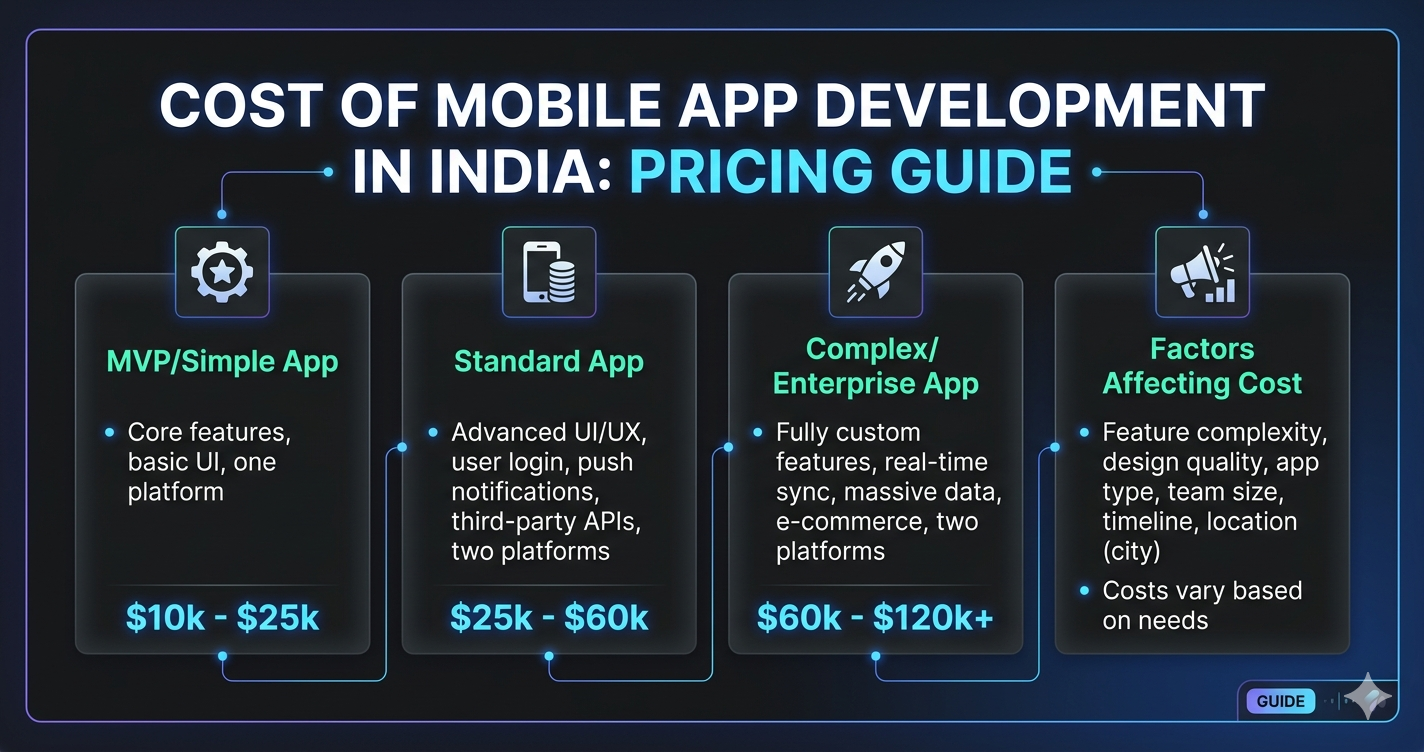
While exact figures are bound to specific project scopes, the baseline mobile app development cost in India typically spans from $10,000 to $150,000+ (approx. ₹8,00,000 to ₹1,25,00,000+ INR). The overarching economic variable is the complexity and feature density of the software architecture.
Basic Mobile App Cost ($10,000 – $25,000)
These are foundational applications featuring standard User Interfaces (UI), localized data storage, and minimal backend integrations. Examples include information directories, basic content management apps, or simple utility tools. They rely heavily on native out-of-the-box templates and require minimal server-side configuration.
Medium Complexity App Cost ($25,000 – $60,000)
Most mainstream corporate and commercial apps fall into this bracket. These solutions feature highly customized UI/UX design architectures, secure payment gateway integrations, real-time synchronization, custom API connections to external corporate databases, social media authentications, and tailored administrative dashboards.
Advanced Mobile App Cost ($60,000 – $150,000+)
Enterprise-grade applications that demand complex microservices backend systems, multi-tenant databases, heavy data encryption, and high concurrent user handling. These apps integrate modern technologies such as artificial intelligence (AI), machine learning algorithms, real-time video streaming, or complex Internet of Things (IoT) hardware syncing.
3. Core Factors Affecting Mobile App Development Cost
Understanding the structural and operational elements that dictate your app development cost India budget ensures predictability and transparency throughout production:
- App Complexity & Feature Matrix: The volume of features—such as geolocation tracking, instant messaging, user profiles, offline synchronization, and dynamic search engines—is the single greatest cost driver.
- UI/UX Design Sophistication: Customized micro-interactions, complex branding exercises, bespoke animations, and detailed user journeys demand extensive hours from expert visual and interaction designers, raising the design allocation.
- Platform Selection Strategy: Choosing between Native platforms (dedicated codebases for Android and iOS) and Cross-Platform frameworks (such as Flutter or React Native) fundamentally balances structural investment against audience reach.
- Development Team Composition: A standard project team typically scales to include a dedicated Project Manager, UI/UX Designers, Frontend Developers, Backend Engineers, DevOps Specialists, and Quality Assurance (QA) Auditors. Seniority and specialization directly influence the hourly rate.
- Third-Party Integrations & APIs: While leveraging third-party microservices (e.g., Stripe, Twilio, Google Maps) speeds up delivery, complex custom API configurations and ongoing commercial licensing add to structural costs.
- Quality Assurance & Infrastructure Maintenance: Extensive automated testing across dozens of device profiles ensures stability. Post-launch expenses—including server hosting, security patches, OS version updates, and scaling optimizations—typically consume 15% to 20% of the initial build budget annually.
Industry Insight:
Over 45% of an application’s long-term budget is shaped during the initial discovery and architectural scoping phases. Defining exact engineering requirements early prevents expensive scope creep later.
4. Android vs iOS App Development Cost Comparison
Platform choices alter the budget due to differences in testing fragmentation, programming languages, and development environments. An Android app development cost can occasionally lean higher during native builds because engineers must test across hundreds of different screen sizes, hardware profiles, and OEM system variants. Conversely, iOS app development cost requires adherence to Apple’s strict human interface guidelines and specialized environment tooling, though testing is limited to a concise matrix of devices.
To optimize deployment budgets, many enterprises prefer Cross-Platform/Hybrid methodologies, leveraging a single shared codebase to target both ecosystems efficiently.
| Development Paradigm | Technology Stack | Estimated Pricing Range (India) | Primary Architectural Advantage |
|---|---|---|---|
| Native Android App | Kotlin, Java | $15,000 – $70,000+ | Maximum hardware integration & market penetration. |
| Native iOS App | Swift, Objective-C | $15,000 – $65,000+ | Flawless user experience & high monetization potential. |
| Cross-Platform / Hybrid | Flutter, React Native | $12,000 – $50,000+ | Single shared codebase, fast updates, 30-40% cost reduction. |
5. Mobile App Development Cost Breakdown by Development Stage
A structured software development lifecycle (SDLC) allocates capital systematically across multiple technical phases to eliminate execution risks:
| Development Stage | Typical Cost Allocation (%) | Estimated Timeline | Core Deliverables |
|---|---|---|---|
| Discovery & Business Analysis | 10% | 2 – 3 Weeks | Functional Specifications (BRD/FRD), project milestones. |
| UI/UX Design & Prototyping | 15% | 3 – 5 Weeks | Wireframes, high-fidelity mockups, interactive prototypes. |
| Backend & Frontend Engineering | 50% | 8 – 16 Weeks | Code repository, core features, server environments, APIs. |
| Quality Assurance & Bug Audits | 15% | 3 – 4 Weeks | Test coverage documentation, regression testing, bug patches. |
| Deployment & App Store Launch | 10% | 1 – 2 Weeks | App Store & Google Play optimization, production live deployment. |
6. App Development Cost Benchmarks Across Industry Verticals
The industry sector heavily influences overall project financial metrics, as security compliance, transaction pipelines, and core functional maps vary significantly by market:
- E-commerce Applications ($15,000 – $45,000): Requires extensive catalog search systems, secure payment step-ups, personalized recommendation carousels, dynamic push marketing, and inventory management web dashboards.
- Food Delivery Solutions ($20,000 – $50,000): Involves a complex ecosystem of three distinct apps: one for the customer, one for delivery riders, and a management console for restaurants, integrated via real-time GPS tracking.
- Healthcare & Telemedicine Apps ($25,000 – $75,000): Demands absolute data privacy compliance (such as HIPAA rules), encrypted video consultations, integrated electronic health records (EHR), and patient appointment scheduling engines.
- EdTech & eLearning Environments ($18,000 – $40,000): Includes video streaming modules, student analytics dashboards, interactive quiz formats, automated certifications, and secure subscription paywalls.
- Real Estate Platforms ($20,000 – $45,000): Relies on advanced geolocation mapping, immersive high-resolution galleries, advanced filter mechanisms, direct agent chat channels, and financial mortgage calculators.
7. Proven Strategies to Reduce Mobile App Development Costs
Maximizing ROI involves choosing smart optimization paths over cutting critical corners. Implement these industry-standard cost-saving strategies:
- Launch with a Minimum Viable Product (MVP): Prioritize building core features that solve your users’ main problems first. Launching an MVP reduces your time-to-market, keeps initial software investments low, and allows you to gather real-world user feedback before committing to expensive enhancements.
- Adopt Cross-Platform Frameworks: Use tools like Flutter or React Native to build for both iOS and Android from a single codebase. This saves significant design and engineering hours compared to writing separate native codebases.
- Leverage Pre-Built Components & Open-Source Tools: Avoid reinventing common systems. Integrating proven open-source packages and cloud services for standard features like authentication, basic chats, and analytical monitoring helps lower custom engineering hours.
- Document Specifications Meticulously: Clear, upfront requirement documentation prevents ambiguous engineering directions, minimizes mid-cycle updates, and protects your project from expensive scope changes.
8. Strategic Advantages of Partnering with an Indian Mobile App Development Company
Outsourcing development to a professional mobile app development company in India remains a highly popular strategy for global corporations and growing startups alike due to several key operational advantages:
- Exceptional Cost-Efficiency: While native developers in North America or Western Europe command hourly rates between $100 and $250, top-tier Indian engineering teams deliver comparable technical quality for $25 to $50 per hour. This significant difference allows businesses to extend their operational runway and allocate more budget to product marketing.
- A Massive Pool of Vetted Talent: India is home to one of the world’s largest collections of certified mobile developers, UX experts, and AI engineers. This deep talent pool makes it easy to scale up your project team quickly as technical requirements evolve.
- Global Quality Solutions: Leading Indian agencies maintain rigorous international certifications (such as ISO and CMMI levels) and use modern agile project management tools, ensuring smooth communication and high-quality deliveries.
- Faster Turnaround Time: Thanks to favorable time-zone differences, Indian development teams can provide around-the-clock product engineering for Western clients. This overlapping schedule accelerates production sprints and shortens your overall development timeline.
9. Frequently Asked Questions (FAQs)
Q1: How much does it cost to build a standard mobile app in India?
A standard mobile application of moderate complexity typically ranges between $25,000 and $60,000 in India. Simple apps can cost as little as $10,000, while highly advanced solutions can exceed $150,000.
Q2: Why is the cost of mobile app development in India so affordable compared to the US?
The affordability stems entirely from the lower cost of living and operational expenses in India. This allows top-tier agencies to offer world-class development services at competitive hourly rates without compromising code quality.
Q3: Should I choose native or cross-platform app development to save budget?
If you are working with a limited budget and want to target both Android and iOS users, cross-platform development (using frameworks like Flutter or React Native) is highly recommended. It saves up to 40% in initial development costs by using a single shared codebase.
Q4: What are the hidden costs associated with custom mobile app development?
Common post-launch expenses include cloud server hosting fees, App Store developer registrations ($99/year for Apple, $25 one-time for Google), third-party premium API renewals, security audits, and ongoing software maintenance.
Q5: How long does it take to develop a mobile application?
A simple application takes roughly 2 to 3 months to build. Medium-complexity projects typically require 3 to 6 months, while complex, enterprise-level digital ecosystems can take anywhere from 6 to 12 months or longer.
Conclusion
Calculating the definitive cost of mobile app development in India involves balancing your business goals, required features, and platform choices. By leveraging India’s rich software development talent, businesses can launch robust, highly scalable, and secure digital products at a fraction of Western development costs.
Whether you choose to launch an MVP using cross-platform tools to test the market or invest in an enterprise-grade native ecosystem, partnering with an experienced development team ensures your product is built to scale smoothly from day one.
Ready to Transform Your Vision into a High-Performing Mobile App?
Work with a trusted mobile app development company in India to build scalable, secure, and intuitive apps tailored to your business needs. Get a custom, no-obligation pricing estimate today.