
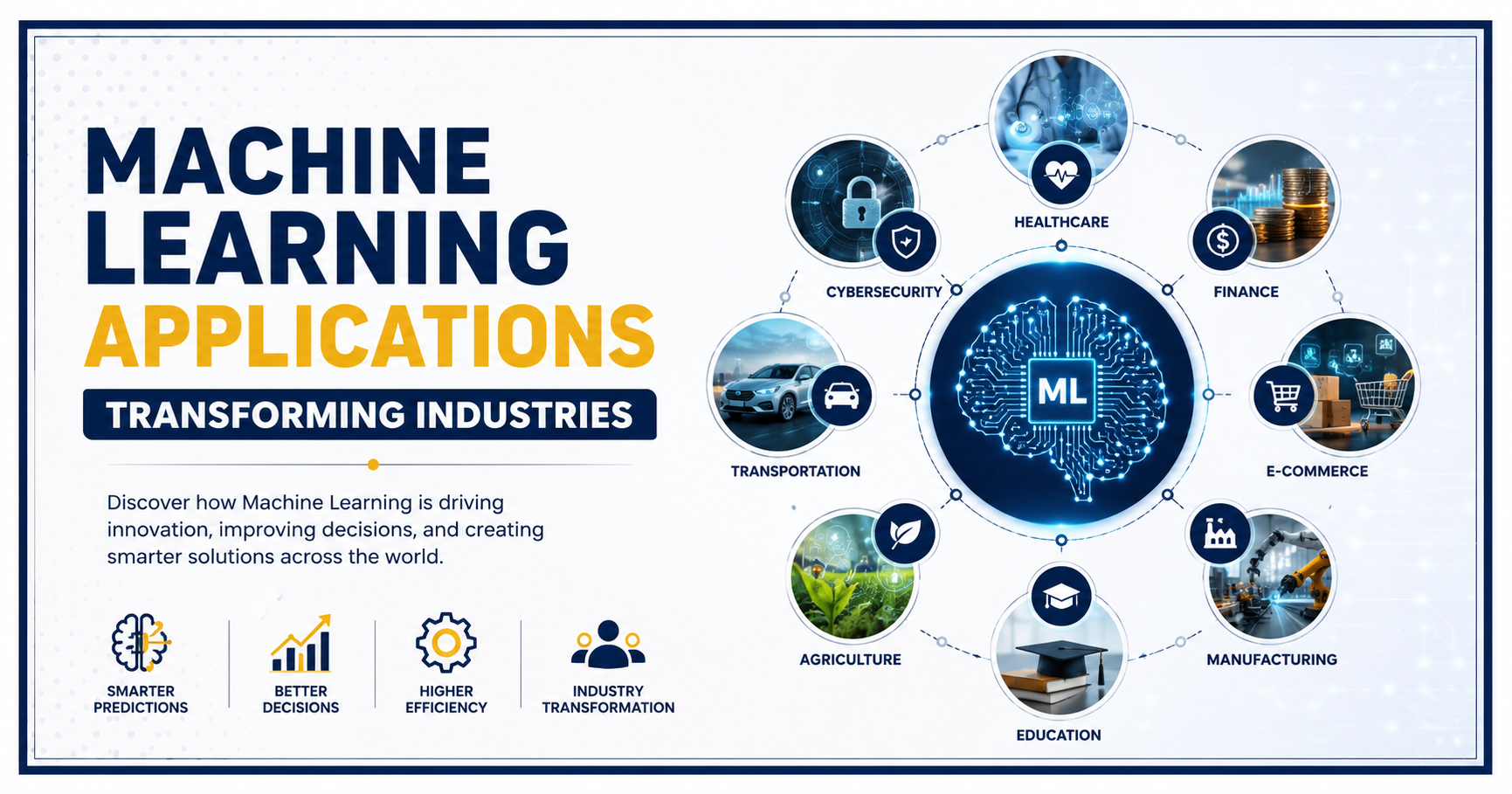
Top Machine Learning Applications Transforming Modern Industries
The rapid evolution of corporate technology has shifted from simple digitization to intelligent automation. At the absolute center of this tectonic shift are Machine Learning Applications. What was once a niche subfield of computer science has rapidly matured into a primary engine driving global business growth, innovation, and strategic adaptation.
To understand why AI applications in business have become indispensable, we must look at how they fundamentally work. In traditional software programming, software engineers manually write strict, rule-based instructions (if/then logic) to guide computers on how to process input data into outputs. Machine Learning completely reverses this logic. Instead of receiving a rigid set of rules, an ML algorithm accepts historical data alongside the desired outcomes, maps out the underlying correlations, and autonomously constructs its own predictive mathematical formulas.
Today, enterprise data volumes are expanding exponentially. Human decision-makers can no longer manually parse these mountains of structured and unstructured information. This is exactly why artificial intelligence solutions have moved from a competitive advantage to an operational baseline. For corporate leadership, technology enthusiasts, and executive stakeholders, mastering contemporary machine learning use cases is critical to building scalable, forward-compatible operations.
1. What is Machine Learning?
At its core, Machine Learning is a branch of artificial intelligence focused on building computational systems that learn from experience. By processing massive datasets, these models continuously refine their mathematical parameters, improving their performance over time without needing human engineers to modify their source code.
To properly leverage these models, data scientists categorize them into three overarching learning paradigms:
- Supervised Learning: This occurs when an algorithm is trained on labeled data—meaning every training input is paired with its explicit correct output. The model learns to map inputs to outputs accurately. Common examples include identifying spam emails based on historical spam tags or predicting real estate pricing using historical home transaction parameters.
- Unsupervised Learning: Here, the algorithm processes raw, completely unlabeled data. Without human instruction, the system scans the dataset to detect hidden patterns, structures, and groupings. This paradigm is highly effective for discovering unexpected relationships or clustering identical buyer personas together.
- Reinforcement Learning: Modeled directly after trial-and-error behavioral learning, this technique uses a system of digital rewards and punishments. An autonomous agent navigates a complex, dynamic environment, taking actions and modifying its operational strategies to maximize cumulative positive rewards over time. This approach underpins autonomous driving software and advanced robotics.
2. Top Machine Learning Applications Across Industries
The structural adaptability of ML algorithms allows them to solve diverse problems across entirely different corporate domains. Let’s look closely at how modern industries utilize these algorithms today:
Machine Learning in Healthcare
The integration of machine learning in healthcare is actively saving lives through vastly improved clinical precision.
- Disease Prediction: By cross-referencing genetic profiles, lifestyle details, and historical electronic health records (EHRs), predictive algorithms identify chronic disease risks long before physical symptoms surface.
- Medical Imaging Analysis: Deep learning networks analyze MRI, CT, and X-ray scans to pinpoint microscopic tumors and structural abnormalities with accuracy rates that rival or exceed expert radiologists.
- Personalized Treatment: ML architectures parse extensive clinical trials to design highly targeted, custom medication and therapy regimens adapted to an individual patient’s biological profile.
Machine Learning in Finance
Institutional systems depend on machine learning in finance to protect assets, evaluate risk profile variables, and execute rapid micro-transactions.
- Fraud Detection: ML engines evaluate millions of credit card transactions in real-time, instantly flagging and blocking anomalous purchases by identifying subtle deviations from standard consumer spending patterns.
- Credit Scoring: Alternative financial data streams alongside historic repayments allow ML models to accurately evaluate creditworthiness for thin-file applicants who lack traditional banking histories.
- Risk Assessment: Advanced predictive platforms parse global market metrics, geopolitical news, and economic indicators to calculate real-time capital exposure risks for investment portfolios.
E-commerce and Retail
- Product Recommendations: Collaborative filtering engines analyze a shopper’s browsing history, clicks, and purchases to display highly relevant product recommendations, driving significant increases in average order value.
- Customer Behavior Analysis: By mapping touchpoints across digital storefronts, predictive models isolate shopping friction points, helping retailers optimize user experiences and minimize shopping cart abandonment.
- Dynamic Pricing: Retail algorithms analyze competitive pricing, real-time demand shifts, inventory levels, and regional buyer habits to adjust product pricing dynamically, maximizing profit margins.
Digital Marketing
- Customer Segmentation: Unsupervised clustering algorithms instantly group massive marketing leads into precise target personas based on engagement habits and transactional histories.
- Predictive Analytics: Marketing teams project the specific lifetime value (LTV) of a new customer account early in the funnel, allowing precise ad-spend allocation.
- Personalized Campaigns: Dynamic copy generation and customized email automation platforms adapt creative messaging in real time based on user interactions.
Cybersecurity
- Threat Detection: Rather than relying solely on static malware signatures, ML models analyze device behavior to isolate zero-day attacks as they happen.
- Malware Identification: Natural language processing (NLP) systems break down executable files to identify malicious commands buried inside otherwise standard software code.
- Network Monitoring: Telemetry monitors evaluate incoming network traffic flows, instantly isolating anomalous data packets to prevent distributed denial-of-service (DDoS) attempts.
Industrial Manufacturing
- Predictive Maintenance: Vibration and thermal IoT sensors stream assembly line data into ML platforms, allowing them to predict machinery breakdowns weeks before they happen to avoid unplanned downtime.
- Quality Control Automation: Computer vision networks scan products moving along assembly belts, identifying and removing items with surface imperfections or microscopic structural flaws.
- Supply Chain Optimization: Demand-forecasting algorithms ingest global freight trends, weather conditions, and seasonal sales patterns to keep warehouse inventory levels highly efficient.
Education
- Personalized Learning: Digital learning platforms assess a student’s strengths and weaknesses, dynamically adjusting lesson difficulty and formatting to match their individual learning pace.
- Performance Prediction: Analytical systems flag students showing early signs of academic struggle, prompting educators to provide targeted interventions before grades drop.
- Intelligent Tutoring Systems: NLP-powered study platforms provide 24/7 step-by-step guidance through complex technical and mathematical concepts.
Transportation and Logistics
- Self-Driving Vehicles: Deep neural networks fuse sensor data from cameras, LiDAR, and radar in real time, making split-second steering and braking decisions.
- Traffic Prediction: Commuter applications analyze historic patterns and crowdsourced real-time reports to forecast gridlock and keep traffic moving smoothly.
- Route Optimization: Delivery algorithms evaluate multi-stop routes, updating dispatch instructions live to reduce fuel costs and ensure on-time drop-offs.
Smart Agriculture
- Crop Monitoring: Drone imagery analyzed by computer vision systems helps farmers identify pest infestations, nutrient deficiencies, or dehydrated crops early.
- Yield Prediction: Algorithms weigh historical harvest cycles, current soil characteristics, and weather projections to estimate total output months before the harvest.
- Smart Irrigation Systems: Automated irrigation lines use soil moisture sensor data and weather forecasts to apply the exact amount of water needed, preserving vital natural resources.
Customer Support and Service
- AI Chatbots: Natural language models manage incoming support tickets independently, resolving common billing or order tracking questions instantly.
- Virtual Assistants: Advanced voice recognition platforms manage complex smart-home ecosystems and handle hands-free productivity tasks seamlessly.
- Automated Customer Support: Intelligent systems sort incoming inquiries by intent and sentiment, routing high-priority corporate support tickets directly to the right specialist.
3. Key Benefits of Machine Learning Integration
Adopting enterprise-grade machine learning yields clear, measurable financial and operational advantages:
- Drastic Operational Efficiency: Automating repetitive, data-heavy analytical workflows frees up human staff to focus on high-value strategic growth initiatives.
- Data-Driven Decision Making: Replacing guesswork with predictive analytics allows executives to base corporate strategy on concrete patterns hidden within their data.
- Long-Term Cost Reduction: While the initial setup requires capital, the long-term returns from avoiding equipment failures, reducing waste, and automating customer support are substantial.
- Hyper-Scalability: ML systems scale effortlessly, processing thousands of new data points or concurrent interactions without a corresponding linear spike in operational overhead.
- Elevated Customer Experiences: Delivering immediate, personalized answers and recommendations builds long-term brand loyalty and improves customer lifetime value.
Ultimately, these combined factors allow modern companies to build highly competitive, agile business operations that scale efficiently.
4. Challenges and Critical Limitations
While the advantages are undeniable, successful integration requires overcoming several known technical and organizational challenges:
5. The Future of Machine Learning Applications
Looking ahead, the next wave of technological evolution promises to unlock even greater capabilities. The line between software tools and intelligent autonomous partners is blurring quickly.
We are tracking several major trends that will reshape the future of machine learning:
- Generative AI Systems: Moving beyond simple predictive analysis, multi-modal neural networks now generate highly coherent text, software code, and creative designs, transforming productivity across creative and technical roles.
- Edge AI Architecture: Moving AI inference directly to edge hardware like mobile phones and IoT devices enables near-zero latency and improved data privacy by eliminating the need to send data back to central servers.
- Explainable AI (XAI): As black-box models handle high-stakes choices in fields like healthcare and law, XAI frameworks ensure systems provide clear, human-auditable rationales for every decision they make.
- Hyper-Personalization: Future digital applications will adapt their entire layouts, navigation logic, and core services dynamically to match an individual user’s immediate emotional state and real-time context.
Machine Learning has evolved from an experimental project into a fundamental pillar of modern business operations. While challenges around data quality and algorithmic bias require careful management, the long-term benefits—including massive scalability, deep operational insights, and automated efficiency—far outweigh the implementation hurdles. Companies that invest in building intelligent, data-driven workflows today are setting themselves up to lead their industries tomorrow.
Ready to Transform Your Business with AI Solutions?
Don’t let your valuable enterprise data sit idle. Partner with our specialist engineering consultants to deploy custom, highly scalable machine learning models tailored to your exact operational challenges.
Frequently Asked Questions
What are Machine Learning Applications?
Machine Learning Applications are software tools and corporate systems that leverage mathematical algorithms to learn from historical data. Instead of being explicitly programmed, these systems improve their accuracy autonomously over time as they process more data.
How is Machine Learning used in business?
Businesses use Machine Learning to optimize operations, including personalizing product recommendations, automating customer support with NLP chatbots, forecasting inventory levels, detecting financial fraud, and executing predictive maintenance on manufacturing equipment.
What industries benefit most from Machine Learning?
While nearly every industry can benefit, the sectors experiencing the most immediate impact are Healthcare (disease prediction and medical imaging), Finance (automated trading and credit risk modeling), E-commerce (personalized shopping experiences), and Manufacturing (predictive maintenance lines).
Is Machine Learning the same as Artificial Intelligence?
No, they are not exactly the same. Artificial Intelligence (AI) is the broader overarching scientific discipline aimed at creating machines capable of mimicking human intelligence. Machine Learning (ML) is a specific subfield of AI focused on building algorithms that learn and adapt entirely from data patterns without static human instructions.
What is the future of Machine Learning?
The future of Machine Learning lies in the evolution of Generative AI, Edge AI (running complex models directly on local hardware), Explainable AI (XAI) to ensure transparency, autonomous vehicles, and widespread hyper-personalization in consumer software and services.