
Conversion Rate Optimization
Website Redesign Services to Boost Conversions: The Complete Guide
Why your site’s design is either quietly winning customers, or quietly losing them.
Every day your website runs on outdated design, it is losing you customers you never see leave. Visitors arrive, glance around, and click away — not because your product is wrong, but because your site failed to earn their trust in the first eight seconds. This is the quiet cost of an ageing website: steady traffic, flat revenue.
Professional website redesign services exist to close that gap. Done well, a redesign is not a cosmetic refresh; it is a structured process to boost conversions by removing every point of friction between a visitor’s intent and their action. This guide walks through the signs you need a redesign, the elements that actually move conversion rates, and the process a good agency follows from audit to launch.
Signs Your Website Needs a Redesign
Most businesses wait too long to redesign, mistaking a slow decline for a stable baseline. Watch for these signals:
- High bounce rate. A bounce rate above 55% often signals that visitors aren’t finding what they expect within seconds of landing.
- Slow load times. A one-second delay in load time can reduce conversions by up to 7%, and sites over 3 seconds lose over half of mobile visitors before the page even finishes loading.
- Poor mobile UX. With most traffic now arriving on phones, a layout that isn’t built mobile-first actively pushes buyers away.
- Outdated visual design. Dated typography, cramped layouts, and inconsistent branding quietly erode trust before a visitor reads a single word of copy.
- Stalled conversion rates. If traffic is steady but conversions aren’t growing, the site itself — not your marketing — is likely the bottleneck.
How Redesign Directly Impacts Conversion Rates
A redesign influences conversions through several interlocking levers, not one single fix:
- UX design reduces the cognitive load required to find and complete an action, so fewer visitors abandon the process out of confusion.
- Trust signals — reviews, security badges, clear contact information — reassure visitors before they hand over money or data.
- Page speed keeps impatient visitors engaged long enough to see your offer.
- Stronger calls-to-action remove ambiguity about what to do next.
- Mobile-first design ensures the majority of your traffic gets a frictionless experience, not an afterthought.
Quick stat: Companies that prioritize UX-driven redesigns typically see conversion rate improvements of 20%–200% within the first six months post-launch.
Key Elements of a Conversion-Focused Redesign
Not every design choice affects conversion equally. A skilled redesign prioritizes:
- Clear, singular calls-to-action on every key page, using contrasting color and direct language.
- Simplified navigation that gets a visitor to their goal in three clicks or fewer.
- Visible trust badges — testimonials, certifications, secure checkout icons — placed near decision points.
- Faster load speed through image compression, code minification, and modern hosting.
- Ongoing A/B testing to validate design decisions with real visitor data rather than assumptions.
- Full mobile responsiveness, designed first for small screens and scaled up.
The Redesign Process, Step by Step
A conversion-focused redesign follows a disciplined sequence:
- Audit. Analyze current analytics, heatmaps, and user behavior to pinpoint exactly where visitors drop off.
- Strategy. Define conversion goals, target audience, and key pages to prioritize.
- Wireframe and design. Build low-fidelity layouts focused on user flow, then apply visual design and branding.
- Development. Build the site with clean, fast, mobile-first code.
- Testing. Run usability testing and cross-device QA before launch.
- Launch. Deploy with proper redirects to protect existing SEO equity.
- Post-launch optimization. Monitor performance and run ongoing A/B tests to keep improving conversion rate optimization results.
A Typical Before & After Scenario
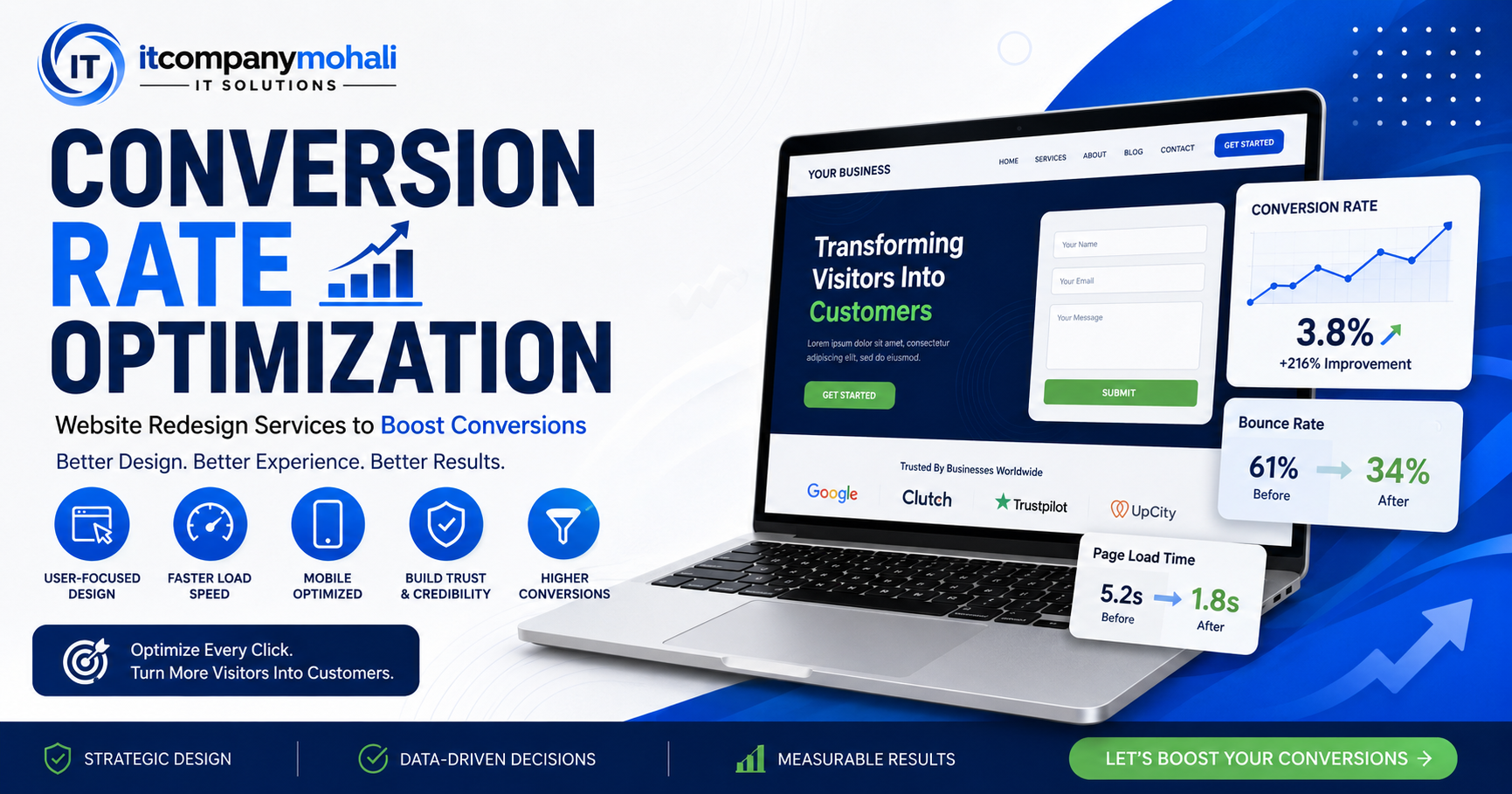
Consider a mid-sized B2B services company running on a seven-year-old website. Traffic was healthy, but the contact form was buried three clicks deep, load time averaged 5.2 seconds, and the layout broke on mobile. After a conversion-focused redesign — including a simplified navigation, a persistent CTA, and mobile-first rebuild — results shifted noticeably within 90 days:
| Metric | Before Redesign | After Redesign |
|---|---|---|
| Bounce Rate | 61% | 34% |
| Conversion Rate | 1.2% | 3.8% |
| Page Load Time | 5.2s | 1.8s |
| Mobile Traffic Retention | 38% | 76% |
Figures are illustrative estimates based on typical outcomes of conversion-focused redesigns, not a specific client engagement.
Common Mistakes to Avoid During a Redesign
- Redesigning without data. Skipping the audit means fixing the wrong problems.
- Prioritizing aesthetics over usability. A beautiful site that confuses visitors still fails to convert.
- Ignoring SEO during migration. Failing to redirect old URLs can erase years of search rankings overnight.
- Treating launch as the finish line. Conversion rate optimization is ongoing, not a one-time event.
- Skipping mobile testing. Desktop-only QA leaves the majority of visitors with a broken experience.
Frequently Asked Questions
How much does website redesign cost?
Most professional website redesign services range from $5,000 to $50,000, depending on site complexity, page count, and custom functionality. Small business projects typically sit at the lower end.
How long does a website redesign take?
A typical redesign takes 6 to 12 weeks from audit to launch. Simple projects can finish in 4 weeks; large or e-commerce sites may take 3 to 6 months.
Will a website redesign hurt my SEO rankings?
Not if it’s planned properly. A qualified agency preserves URL structure with 301 redirects and improves technical SEO, often boosting rankings rather than harming them.
How do I know if my website actually needs a redesign?
Watch for a bounce rate above 55%, load times over 3 seconds, poor mobile responsiveness, dated visuals, and a conversion rate that has plateaued despite steady traffic.
Ready to Turn Your Website Into a Conversion Engine?
A slow, outdated site is a solvable problem, not a permanent one. Professional website redesign services combine UX design, page speed optimisation, and mobile-first thinking to boost conversions and turn existing traffic into revenue. The businesses that act now compound the gains; the ones that wait keep losing customers they’ll never see.